10 Best Industrial Fans for Global Buyers?
Choosing among the 10 Best Industrial Fans for Global Buyers requires more than comparing airflow figures. A fan that performs well in a clean warehouse may struggle in a dusty cement plant. Climate, operating hours, static pressure, noise limits, and available electrical supply can change the decision completely. Voltage and frequency also vary between markets. That detail is easy to overlook.
Michael Turner, an industrial ventilation engineer, offers a practical warning: “The largest fan is rarely the best fan; the right fan delivers required airflow with sensible energy use.” His point deserves attention. Bigger is not always better.
This guide examines Industrial Fans through a buyer’s real operating conditions. It considers axial, centrifugal, roof, exhaust, HVLS, and explosion-resistant designs. Each type serves a different purpose. Some move large air volumes at low pressure. Others handle resistance from filters, ducts, or process equipment. Materials also matter. Galvanized steel may suit ordinary facilities, while stainless steel can better resist moisture and chemical exposure.
Reliable selection also involves motor efficiency, variable-speed control, guarding, maintenance access, warranty support, and replacement-part availability. International buyers should verify applicable certifications and local installation requirements. A product brochure cannot reveal everything. Field performance may differ.
This ranking is useful, but it is not perfect. Actual results depend on layout, installation quality, and maintenance discipline. Buyers should confirm airflow and pressure data before ordering. The quietest model may not be the most durable. The cheapest unit may cost more over time. Careful comparison remains essential.
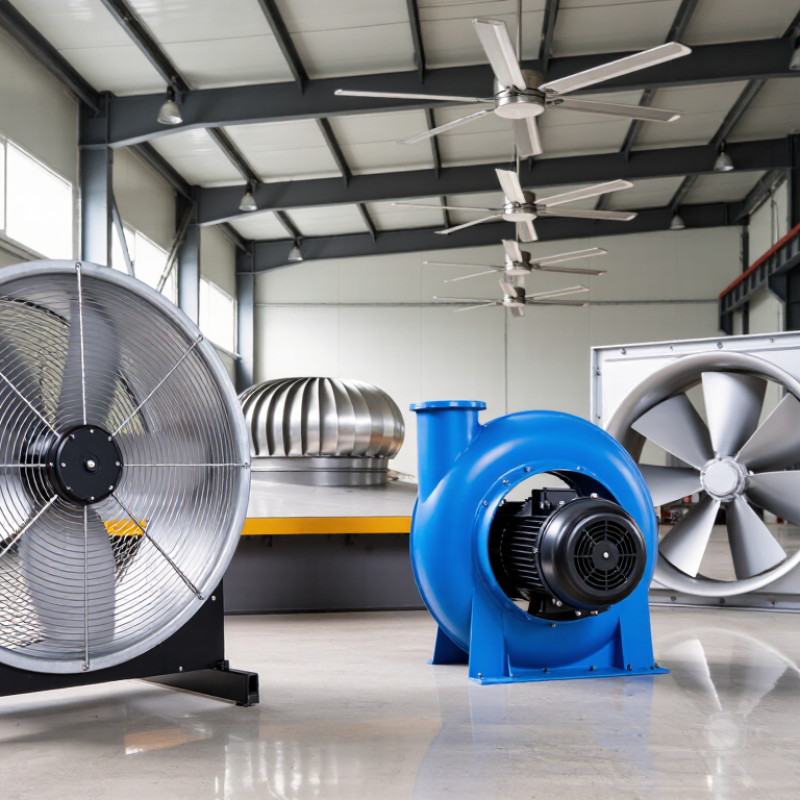
Industrial Fan Fundamentals: Airflow in CFM and Static Pressure in Pa
10 Best Industrial Fans for Global Buyers?
Industrial Fan Fundamentals: Airflow in CFM and Static Pressure in Pa
Choosing an industrial fan starts with two measurements: airflow and resistance. CFM shows how much air the fan moves each minute. Static pressure, measured in pascals (Pa), shows how strongly it pushes against resistance. A warehouse exhaust system may need high CFM, while a long duct, filter, or narrow grille demands greater Pa. Selecting only by motor size is a common mistake.
In practical installations, I compare the required airflow with the fan curve at the expected pressure. For example, a system needing 8,000 CFM at 450 Pa should be checked at that exact operating point. Free-air ratings can look impressive but may collapse after ducts and filters are connected. Measure duct dimensions, count bends, and allow for dirty filters. I have seen careful estimates fail because one overlooked damper changed the pressure significantly.
Tips: Record airflow and pressure during commissioning. Use a calibrated instrument when possible. Leave a reasonable margin, but avoid excessive capacity. Oversized fans can waste energy and create uncomfortable drafts. A clean calculation helps. Yet real systems are rarely perfect, so inspect noise, vibration, and actual airflow after installation.
10 Industrial Fan Types: Airflow and Static Pressure Reference
Representative engineering reference points for global buyers. Airflow is shown in CFM, while static pressure is shown in Pa. Actual performance depends on fan size, speed, system resistance, temperature, and operating point.
Higher airflow supports greater air volume movement, while higher static pressure indicates a stronger ability to overcome ductwork, filters, dampers, and other system resistance. Fan selection should be based on the required duty point rather than airflow alone.
Motor Efficiency: IE3/IE4 Classes and kW per 1,000 m³/min
Industrial fan buyers often compare IE3 and IE4 motors as if the label predicts total fan efficiency. It does not. IEC 60034-30-1 defines motor efficiency classes, while fan performance also depends on impeller design, pressure, controls, and operating point. The European Commission’s Ecodesign Regulation 2019/1781 supports higher motor efficiency requirements in many applications. However, an IE4 motor cannot rescue an oversized fan.
A more useful benchmark is kW per 1,000 m³/min at a stated pressure. At 1,000 m³/min, airflow equals approximately 16.7 m³/s. Producing 1,000 Pa requires about 16.7 kW of air power. With 70% total efficiency, electrical demand reaches roughly 23.8 kW. At 80%, it falls near 20.9 kW. Small differences become expensive in continuous operation. Pressure matters greatly.
Do not compare airflow alone.
The International Energy Agency reports that electric motor systems consume roughly half of global electricity, making efficiency improvements commercially important. AMCA 208 also promotes fan energy metrics based on pressure and airflow, rather than motor ratings alone. In procurement, request tested airflow, static pressure, total efficiency, motor class, and measured input kW. Variable-speed control can reduce energy sharply when demand changes, although savings depend on the system curve and control settings. This is where specifications become imperfect: published values may reflect laboratory conditions, not dusty ducts, blocked filters, or poor commissioning. A careful buyer should allow for those losses.
Fan Types Compared: Axial, Centrifugal, HVLS, and Explosion-Proof
Choosing among axial, centrifugal, HVLS, and explosion-proof fans depends on airflow, pressure, space, and operating hazards. Industrial buyers should begin with the duty point, not the catalogue headline.
Axial fans move large air volumes through open spaces with modest resistance. They suit warehouses, workshops, and general ventilation.
Centrifugal fans create higher static pressure, making them useful for ducts, filters, and fume extraction. Their housings often need more floor space.
HVLS fans rotate slowly beneath wide ceilings, gently mixing warm and cool air. They improve comfort and temperature consistency, but they cannot replace a properly designed exhaust system.
Explosion-proof fans require closer attention. They are designed for areas where flammable gases, vapors, or dust may exist. Certification, motor protection, temperature rating, and installation method must match the site classification.
“Safe” is not a universal label. Local engineers should verify the complete assembly, including switches and wiring.
Measure actual conditions. Use an anemometer at occupied height, inspect duct pressure, and record ambient temperature.
Check noise, vibration, maintenance access, and spare-part availability before purchase.
I have seen installations fail because airflow looked impressive, while static pressure was ignored. That mistake is expensive.
Another practical concern is corrosion near coastal sites. Stainless hardware may be worth the extra cost. Fan selection is rarely perfect on the first attempt; operating data often challenges the original specification.
Global Compliance: AMCA 210, ISO 5801, IEC 60034, and IP55
Global buyers need more than a high airflow number. AMCA 210 and ISO 5801 provide standardized methods for measuring fan airflow, pressure, and performance. Their test arrangements differ, so published curves should not be compared blindly. Ask for the exact test standard, operating point, air density, and measurement uncertainty.
IEC 60034 supports motor safety, ratings, and performance requirements. However, IEC compliance for the motor does not automatically certify the complete fan assembly. IP55 means protection against harmful dust deposits and water jets from any direction. It is not waterproof or suitable for immersion. The International Energy Agency reports that motor-driven systems consume roughly half of global electricity. The U.S. Department of Energy’s Improving Fan System Performance sourcebook also identifies potential savings of 20–50% in many fan systems. Efficient selection is therefore an operating decision, not only a purchasing decision.
Tips: Request a test report, motor nameplate, efficiency class, duty point, and IP test evidence. Check voltage and frequency before ordering. Confirm whether the stated performance includes guards, filters, silencers, or duct resistance. A certificate can look convincing, yet the wrong test condition may distort the result. I would also leave room for honest uncertainty, because field performance can differ from laboratory data.
Ranking 10 Fans by Energy Use, Noise dB(A), Duty Cycle, and TCO
For global buyers, the best industrial fan is not simply the one with the highest airflow. This practical ranking weighs energy use, noise, duty cycle, and total cost of ownership (TCO). The order is: 1) EC backward-curved centrifugal, 2) VFD centrifugal, 3) plug fan, 4) mixed-flow, 5) vane axial, 6) tube axial, 7) high-pressure radial, 8) roof exhaust, 9) drum fan, and 10) portable axial fan. EC and VFD models usually deliver stronger part-load performance. Axial models often cost less, but they can produce higher noise near operating limits.
The U.S. Department of Energy’s fan-system guidance shows that flow control and motor efficiency can create meaningful electricity savings, especially in systems running continuously. The International Energy Agency reports that electric motor systems consume roughly half of global electricity, making fan efficiency a serious operating issue. AMCA 208 also supports comparing fan energy performance through the Fan Energy Index (FEI). Noise should be checked at the stated distance, because 75 dB(A) in a test room may feel much louder beside a steel production line. Duty cycle changes everything. A low-cost fan running 8,000 hours annually may become the most expensive choice. This ranking is imperfect without site data, and that limitation deserves attention.
Tips: Request certified airflow, pressure, FEI, dB(A), duty-cycle, and service-life data. Calculate TCO using electricity, filters, bearings, controls, downtime, and local labor rates. Leave a margin for dust buildup, but avoid oversized fans; throttling wasted air is still wasted energy.
10 Best Industrial Fans for Global Buyers? — Ranking 10 Fans by Energy Use, Noise dB(A), Duty Cycle, and TCO
Methodology and assumptions: Values are representative engineering figures for commonly specified industrial fan configurations, not brand-specific product claims. Annual energy use assumes 4,000 operating hours per year, the stated duty-cycle factor, and an electricity price of US$0.12/kWh. Five-year TCO includes indicative purchase, installation, energy, preventive maintenance, and replacement-component costs; taxes, freight, building modifications, and downtime are excluded. Noise values are typical free-field readings at 1 m and may vary with installation, inlet conditions, ductwork, and operating point. Actual selection should be verified against certified fan curves, local electrical standards, hazardous-area requirements, and site noise limits.

