China Best Olylife Foot Massager Supplier for Buyers
Choosing a China-based Olylife Foot massager supplier involves more than comparing catalog prices. Buyers should confirm the exact model, intended use, operating modes, materials, and included accessories. Ask for clear product photographs and a sample when practical. A control panel that looks simple online may feel different during daily use.
Reliable sourcing depends on evidence. Request current product specifications, inspection procedures, warranty terms, and packaging details before placing an order. Check whether the supplier can explain how defects are recorded and handled. If a feature or certification matters in your market, ask for documentation and verify it independently. Do not rely on a logo or a broad quality claim alone. Details matter.
Communication is part of the evaluation. A capable contact should answer specific questions about production timelines, order quantities, customization, and shipping arrangements without promising what cannot be confirmed. Compare written quotations carefully; freight, spare parts, and after-sales support can change the real cost. A polished catalog is not proof. Nor is the lowest price. Buyers should also consider whether product instructions are clear and whether replacement components can be discussed before an order.
No supplier can remove every sourcing risk. Samples may not reveal long-term comfort, and production batches can vary. That deserves honest attention. Keep requirements in writing, agree on acceptance checks, and retain relevant records. This practical approach helps buyers assess an Olylife Foot supplier with clearer expectations, fewer assumptions, and a stronger basis for a lasting business relationship.
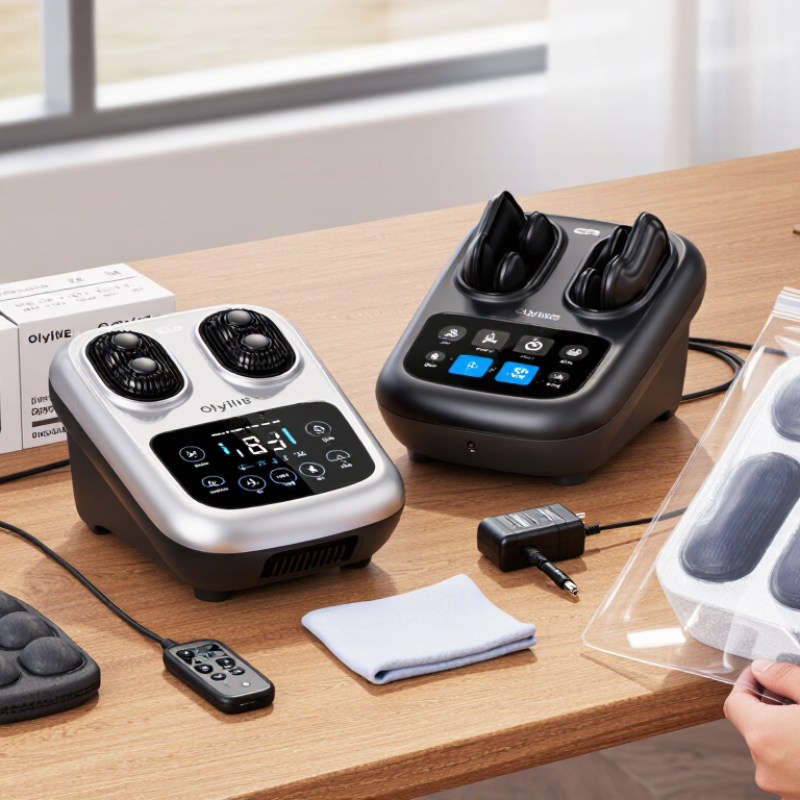
Understanding Olylife Foot Massagers and Their Key Features
Understanding Olylife Foot Massagers and Their Key Features
A foot massager’s main job is to provide adjustable comfort, not diagnose or treat a condition. Common designs combine rolling or kneading nodes with air-compression chambers. Some also offer gentle heat. These features feel different: rollers press specific points, while compression wraps around the foot. Try low intensity first. A setting that feels relaxing after a long shift may feel too strong on a sensitive arch.
Fit and control matter as much as feature count. Check the stated foot-size range, whether the heel stays in place, and whether the controls are reachable while seated. A washable liner helps with routine cleaning. Heat should be adjustable or switchable; more warmth is not always better. A control panel can look impressive, yet unclear buttons make daily use frustrating. Comfort is personal.
The American Podiatric Medical Association’s 2014 consumer survey reported that 77% of adults had experienced foot pain. That survey describes reported experience, not proof that massage devices relieve pain. Buyers should treat massage as a comfort feature, not a medical claim. People with reduced foot sensation, circulation problems, or persistent pain should ask a qualified clinician before using heat or strong compression. Small details matter. A quiet motor and an easy-to-clean interior can make the device more practical at home.
Why Buyers Source Olylife Foot Massagers from China
China attracts buyers of foot massagers because many manufacturing regions offer component suppliers, assembly services, and export support within one sourcing network. That can make product customization and repeat ordering more practical. Buyers may request changes to massage modes, control labels, packaging, or plug specifications. Details matter.
Factory visits or live video inspections can reveal how units are assembled. Ask to see motor testing, wiring checks, and finished-product inspections, rather than relying only on catalog photos. A sample should be tested for noise, pressure consistency, button response, and comfort during a realistic session. Small differences become obvious after ten minutes.
Price is only part of the decision. Compare quotations against materials, included accessories, packaging, production lead time, and warranty terms. Request written inspection criteria and confirm how defects are recorded and handled. Communication can be efficient, but time zones and translation sometimes slow clarification. Plan for that.
Not every supplier has the same technical depth, and a polished sample does not guarantee every production batch will match. Buyers should check references, verify business details, and approve a pre-production sample before placing a larger order. A clear specification sheet helps both sides catch avoidable misunderstandings. It is still imperfect, but far safer than guessing.
How to Find and Verify a Reliable Olylife Supplier
Finding a reliable foot-massager supplier takes more than comparing prices. Check that its registered business name, factory address, and payment details match across records. Ask who manufactures the unit and whether production can be inspected. The OECD and EUIPO estimated counterfeit goods represented up to 2.5% of world trade in 2019, worth up to US$464 billion. This broad trade figure is not specific to massagers, but it shows why supplier claims deserve independent checks.
Tips: Request a current quality-system certificate and test reports for the exact model. Confirm the issuing organization independently; a PDF alone proves little. Order a production sample. Compare its plug, controls, stitching, label, and packaging against the written specification.
For electrical safety, ask whether the product was evaluated against applicable requirements, such as IEC 60335-2-32 for massage appliances, and verify the report with the testing laboratory. A video factory tour can help, but it cannot replace an audit or consistent production records. Keep approved samples, defect limits, delivery terms, and warranty responsibilities in writing. One awkward detail: even a capable supplier may miss a specification, so document what happens when that occurs.
Comparing Product Quality, Customization, and Certifications
When comparing Chinese suppliers of foot massagers, look beyond polished product photos. Request a production sample and test it through several sessions. Check whether the rollers move evenly, pressure feels comfortable, and buttons respond without delay. Listen for rattling on a quiet floor. Small details matter. Inspect the seams, cable strain relief, and stability of the foot cradle. Ask for the same model configuration planned for the bulk order. A showroom sample may be better finished than later units; that gap deserves attention, not assumption.
Customization should be specified in writing. Confirm options for color, packaging, plug type, controls, and user manuals before approving a sample. Ask which changes affect tooling, lead time, or minimum order quantities. No checklist catches everything. For certifications, request documents linked to the exact model and factory, then verify their scope, issuing body, and validity. Requirements vary by destination market, so check applicable electrical safety, electromagnetic compatibility, and material rules with a qualified compliance professional. A certificate for a similar product may not cover the version you intend to buy. Even careful document checks can leave questions; clear records and consistent production checks help reduce that uncertainty.
Foot Massager Supplier Evaluation: Compliance Checks by Market
A practical starting point for comparing supplier documentation—not a supplier ranking.
A value of 1 means the framework is commonly relevant to check for the target market; 0 means it is not a universal product approval. Applicability depends on the product and destination: CE marking is the manufacturer’s conformity marking for applicable EU rules, RoHS applies to covered electrical and electronic equipment, and FCC requirements depend on the device’s electronics and radio functions. UL/ETL certification is not universally required, while ISO 9001 certifies a quality-management system rather than a specific product. Verify current requirements and request product-specific evidence from each supplier.
Evaluating Pricing, Shipping, and After-Sales Support
When comparing suppliers of foot massagers, look beyond the quoted unit price. Ask whether it includes accessories, export packaging, and any setup costs. Small details matter. A quote should also state its validity period and minimum order quantity, so buyers can compare like with like.
Shipping estimates need practical details. Request the production lead time, carton dimensions, gross weight, and available shipping methods. A compact sample carton may arrive quickly, while a larger order can face different transit times and charges. Confirm who handles customs paperwork and whether duties are included; these costs depend on the destination. Delivery dates are estimates, not promises, so leave a buffer for delays.
After-sales support is easier to judge when expectations are written down. Check the warranty period, process for reporting a fault, and availability of replacement parts such as power adapters or control panels. Ask how quickly the supplier typically responds and what photos or order records are needed for troubleshooting. Clear answers are reassuring, though they cannot prevent every issue. Even a careful comparison can miss something, so keep the first order modest enough to assess product quality, packaging, and communication.

