Get an estimate

China Top Pop-up Socket Suppliers for Global Buyers

China has become a major sourcing base for workplace connectivity hardware. Its supplier network covers injection molding, metal stamping, wiring, USB charging, and final assembly. That combination matters when buyers compare Pop-up Socket manufacturers for offices, kitchens, conference tables, and hospitality projects.

Market evidence supports this direction. Grand View Research valued the global office furniture market at approximately USD 54.8 billion in 2023, with workplace redesign supporting demand for integrated power access. Fortune Business Insights also identifies smart-office adoption as a long-term growth area, driven by connected devices and flexible workspaces. These reports do not measure Pop-up Socket sales directly. That limitation matters. Product-specific figures are still fragmented across regions and suppliers.

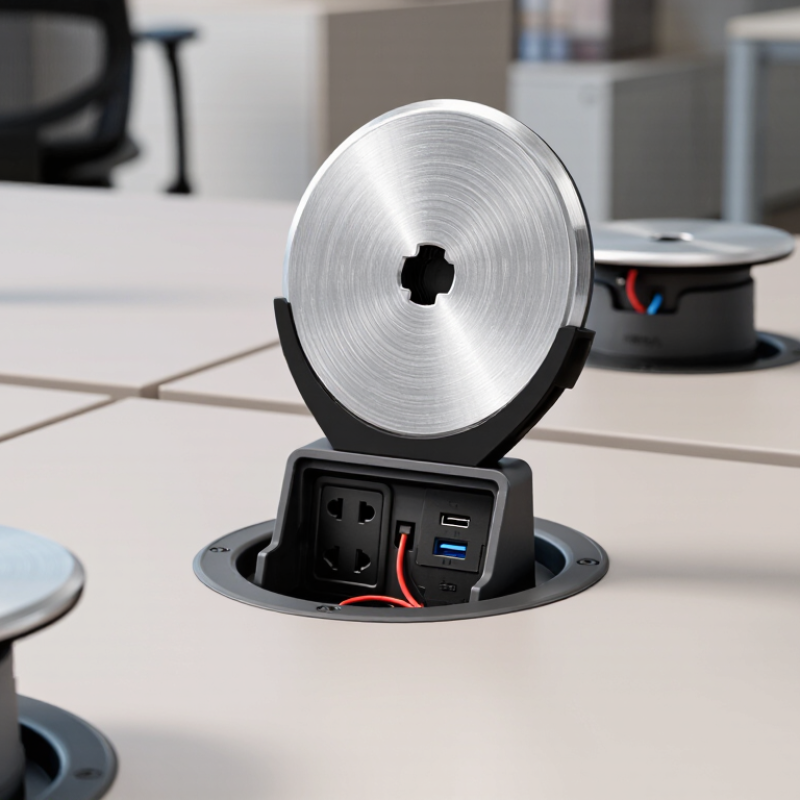
Bachmann Group executive David Steel has described the design goal clearly: “Power access should support the workspace without becoming its visual focus.” Buyers can see this principle in practical details: a brushed-metal lid, a 60-millimeter cutout, a soft-close mechanism, or a USB-C port beside an AC outlet. Small details reveal manufacturing discipline.

Reliable sourcing requires more than a low quotation. Global buyers should review load ratings, material certificates, factory audits, sample consistency, cable quality, and applicable electrical approvals. Suppliers must also explain installation depth and replacement procedures. Some listings look polished but provide weak documentation. That is where careful evaluation becomes essential.

China’s strongest suppliers can offer customization, stable production, and competitive lead times. Yet no supplier should be accepted on claims alone. This guide examines the evidence.

China Top Pop-up Socket Suppliers for Global Buyers

What Are Pop-up Sockets and How Do They Work?

Pop-up sockets are recessed electrical units that rise from a desk or countertop when needed. Pressing the cover usually releases a spring-assisted lifting mechanism. The socket then extends through a guided track. After use, another push lowers it below the surface. Inside, separate modules may provide power, USB charging, or data connections. The visible housing protects the unit when it is closed.

In practical installations, alignment matters more than many buyers expect. A socket needs a correctly sized cutout, stable support, and enough clearance below the surface. Professional installers should check voltage ratings, grounding, cable strain, and heat buildup. Some models resist splashes, but water resistance is not waterproof protection. The mechanism is useful, yet not foolproof. Dust, crumbs, or a poorly fitted cover can affect movement over time. I have found that simple products still need careful measurements and realistic usage checks.

Tips: Confirm the cutout size before ordering. Check the lifting height and panel thickness range. Choose certified electrical components for the target market. Test the unit several times after installation. Do not force a stiff mechanism. A small alignment error can become a daily annoyance.

Why Choose Chinese Pop-up Socket Suppliers?

Chinese pop-up socket suppliers attract global buyers through manufacturing depth, practical customization, and competitive production costs. UNIDO’s International Yearbook of Industrial Statistics 2024 places China at roughly one-third of global manufacturing value added. That scale supports access to metal stamping, injection molding, cable assembly, and surface finishing within shorter supply chains.

The electrical category is also substantial. UN Comtrade data for 2023 identifies China as a leading exporter under HS 8536, covering electrical apparatus for switching or protecting circuits. This does not represent pop-up sockets alone. Still, it shows strong export experience in related electrical components. Experienced suppliers can adjust socket layouts, cable lengths, mounting depths, and tabletop finishes for offices, kitchens, hotels, and conference rooms. Small details matter. A stiff lifting mechanism can damage a desk panel.

Reliable sourcing requires more than a low quotation. Buyers should request material specifications, wiring diagrams, load tests, factory inspection records, and samples from the intended production line. Products should match applicable IEC requirements and the destination market’s electrical rules. Independent testing can verify grounding, insulation, heat resistance, and repeated-use performance. These checks may add time, but they reduce expensive failures. Some suppliers still present attractive samples while production consistency remains uncertain. That weakness deserves honest review. Reference checks, batch inspections, and clear warranty terms help turn manufacturing capacity into dependable purchasing.

China Top Pop-up Socket Suppliers for Global Buyers: Why Choose Chinese Suppliers?

China accounted for approximately 14.2% of world merchandise exports in 2023, the largest share among the leading exporting economies shown. This global trade scale supports broad manufacturing capacity, established logistics networks, and flexible export services—important considerations when evaluating pop-up socket suppliers.

Source: World Trade Organization, World Trade Statistics 2024. The figures represent total merchandise exports and are not specific to pop-up sockets.

How to Evaluate Supplier Quality, Certifications, and Capacity

China Top Pop-up Socket Suppliers for Global Buyers

Evaluating a pop-up socket supplier starts with the product, not the brochure. Request production samples from regular batches, not specially prepared units. Check the lifting mechanism for smooth travel, firm locking, and minimal side movement. Inspect cable routing, socket alignment, surface finish, and heat resistance. A useful test includes repeated opening cycles and continuous electrical load. Record failures, noise, and temperature changes.

Certifications need careful verification. Ask for complete certificates, test reports, issuing laboratory details, and matching model numbers. Confirm whether documents cover the exact socket configuration, wiring system, and intended market. Certifications such as ISO 9001 show process control, but they do not prove every product is reliable. Check electrical safety, material restrictions, grounding, and local plug requirements. A certificate copy can look convincing. Verify it independently.

Capacity requires evidence. Review monthly output, line equipment, staffing, inspection stations, and component stock. Ask how the factory handles sudden order increases without skipping tests. Compare promised lead times with recent delivery records. Request a quality-control flow, including incoming inspection, assembly checks, and final testing. Factory audits can reveal practical weaknesses, such as crowded worktables or handwritten records. That is not an automatic rejection, but it deserves follow-up. Some buyers focus too heavily on price and overlook replacement parts, packaging damage, or installation support. That judgment can become expensive.

Key Pop-up Socket Types for Different Global Applications

Pop-up sockets serve different spaces, so global buyers should match the mechanism to the working environment. Manual countertop units suit kitchens, training rooms, and shared desks. They rise with a light push and remain simple to maintain. Motorized models offer smoother movement for executive offices and conference tables. They need a stable power supply and more careful installation.

Desktop grommet sockets fit compact workstations where every centimeter matters. They usually combine power outlets, USB charging, and data connections. Floor pop-up boxes support meeting areas, retail counters, and flexible offices. Their covers must resist foot traffic and occasional spills. Outdoor or hospitality applications require stronger sealing and corrosion-resistant materials. Not every “water-resistant” claim means the same thing.

During supplier evaluation, inspect cable routing, hinge strength, surface finish, and replacement-part access. Ask for load tests, dimensional drawings, and destination-market certification documents. Samples reveal problems that catalogs often hide. A socket may look elegant but feel loose after repeated use. That matters.

Experienced buyers also compare noise, installation depth, and cleaning time. These details affect long-term ownership costs. One imperfect assumption is common: more functions do not always create more value. Extra ports can increase heat, wiring complexity, and service risk. Reliable suppliers explain these trade-offs clearly and adapt socket types to local furniture, voltage, and workplace habits.

How Global Buyers Can Source and Import from China

Sourcing pop-up sockets from China starts with a clear product brief, not a low price. Define socket types, voltage, frequency, materials, dimensions, and installation methods. Share drawings or reference photos with several qualified manufacturers. Ask for factory profiles, production capacity, export experience, and recent test reports. A responsive supplier should explain limitations instead of promising everything.

Request samples before discussing large quantities. Check the lifting mechanism, cable length, surface finish, child-safety features, and heat resistance. Test the socket repeatedly. Small faults often appear after daily use. Confirm whether the sample matches mass production materials. This step can feel slow, but it prevents expensive rework. I would also inspect the factory or hire an independent auditor, because documents alone cannot show assembly discipline.

Import planning needs equal attention. Confirm the HS code with a customs professional in the destination market. Review product standards, labeling, plug requirements, packaging, and required certificates before payment. Agree on inspection points, acceptable defect limits, delivery terms, and replacement procedures in writing. Use a secure payment arrangement and keep invoices, packing lists, transport documents, and inspection records organized. A trial order is usually safer than a large first shipment. Even experienced buyers can underestimate port delays, carton damage, or changing compliance rules. Leave space in the schedule for corrections.

China Top Pop-up Socket Suppliers for Global Buyers - How Global Buyers Can Source and Import from China
Data Dimension Practical Information for Global Buyers Recommended Sourcing and Import Verification
Product Categories Desktop pop-up socket Motorized retractable unit Manual lift unit Floor-mounted pop-up box Select the product according to installation location, available cabinet depth, required number of outlets, and whether the unit must be flush with the work surface when closed.
Power Configuration Common configurations combine AC power outlets with USB charging ports, data ports, or multimedia connectors. Outlet formats and electrical ratings differ between markets. Specify the destination country before quotation. Confirm plug geometry, outlet configuration, rated voltage, rated current, frequency, grounding method, and compatibility with local wiring regulations.
Rated Electrical Parameters The rated voltage and current must be stated on the product label and technical documentation. These values are not universal because socket standards vary by destination market. Request photographs of the rating label, wiring diagram, product specification sheet, and test report for the exact model and exact outlet configuration being purchased.
Relevant International Standards Depending on product construction and market, applicable references may include IEC 60884-1 for plugs and socket-outlets, IEC 62368-1 for certain audio/video and information-technology equipment, and applicable low-voltage and electromagnetic-compatibility requirements. Do not rely only on a general certificate. Confirm that the certificate or test report covers the exact model, electrical rating, outlet format, USB module, motorized mechanism, and destination market.
Materials and Construction Common materials include aluminum alloy, stainless steel, flame-retardant engineering plastics, copper-alloy conductive parts, and insulated internal wiring. Request material declarations, flame-retardancy information where applicable, conductor cross-section, contact material, surface-finish details, and corrosion-resistance evidence for humid or coastal installations.
Ingress Protection An IP rating describes protection against solid particles and water under defined test conditions. For example, IP44 provides protection against solid objects above 1 mm and water splashes from all directions; it is not a waterproof rating for immersion. Use an IP-rated model only when the rating is supported by a valid test report for the complete assembled product, including the cover, seams, cable entry, and installed configuration.
Size and Installation Key dimensions include visible panel size, cut-out diameter or length, product height, cabinet clearance, cable exit position, and mounting method. Provide a dimensioned cut-out drawing before production. Confirm countertop thickness, internal obstruction clearance, mounting clamps, ventilation requirements, and minimum bending radius for power cables.
Safety Features Relevant features may include grounding, overload protection, child-protection shutters, thermal protection, soft-start or limit control for motorized units, and protection against accidental operation. Ask for functional-test procedures covering grounding continuity, insulation resistance, dielectric strength, temperature rise, repeated operation, and motor travel limits where applicable.
USB Charging Modules USB-A and USB-C modules may be supplied as standard charging ports or as power-delivery charging modules. Charging output depends on the installed electronic module and its certification. Verify output voltage, maximum current, total power, power-sharing behavior, standby consumption, connector type, and safety documentation for the exact USB module.
Environmental Compliance Buyers supplying the European Economic Area commonly review RoHS requirements and REACH obligations. Other markets may impose separate restrictions on hazardous substances, packaging, or electronic waste. Request a current material declaration, restricted-substance test report, and supplier compliance statement. Check whether the declaration covers the socket, cable, plastics, coatings, solder, and electronic modules.
Quality-Control Documents Useful documents include an approved sample, bill of materials, inspection specification, production test record, packing list, commercial invoice, and carton-marking specification. Agree on measurable acceptance criteria before placing the order. Use pre-shipment inspection to check appearance, dimensions, function, electrical safety, accessories, labeling, and packaging quantity.
Customization Scope Typical customization may cover outlet format, panel finish, cable length, connector combination, logo-free packaging, carton design, mounting hardware, and control method. Treat customized drawings, samples, artwork, and engineering changes as controlled documents. Approve a production sample before mass manufacturing and record all deviations in writing.
Packaging Requirements Suitable packaging normally includes individual protection for finished surfaces, immobilization of moving parts, moisture protection, impact-resistant inner packing, and export-grade outer cartons. Specify carton dimensions, gross and net weight, pallet requirements, drop-test expectations, product orientation, spare-parts quantity, warning labels, and barcode requirements before shipment.
Shipping Documents International shipments commonly require a commercial invoice, packing list, transport document, and any applicable certificate of origin or conformity documentation. Ensure that model numbers, quantities, product descriptions, weights, values, consignee details, and package marks are consistent across all documents to reduce customs delays.
HS Code Classification The correct customs classification depends on the product’s primary function, electrical construction, integrated modules, and the importing country’s tariff interpretation. Do not select a tariff code solely from a supplier quotation. Ask a licensed customs broker or the importing customs authority to confirm the classification before shipment.
Trade Terms Common Incoterms include EXW, FOB, CIF, and DDP. Each term allocates different responsibilities for export clearance, freight, insurance, import clearance, duties, and final delivery. Compare quotations on the same Incoterm and destination basis. Confirm who pays export charges, destination handling, customs duties, taxes, inspection fees, and last-mile delivery.
Payment Protection International orders may use staged payments, documentary arrangements, or other mutually agreed settlement methods. The commercial risk depends on payment timing and inspection rights. Link final payment to objective milestones such as approved samples, production completion, inspection results, and receipt of compliant shipping documents.
Supplier Due Diligence A reliable sourcing review examines manufacturing capability, export experience, quality systems, testing resources, engineering support, and traceability of purchased components. Request business registration information, factory or production-site evidence, recent relevant test reports, process photographs, sample records, and references for comparable product types without relying on certificates alone.
Import Planning Total landed cost includes product price, tooling or sampling charges, inspection, export handling, international freight, insurance where applicable, customs duties, taxes, destination charges, and inland delivery. Prepare a landed-cost worksheet before ordering. Include exchange-rate movement, spare parts, replacement units, compliance testing, customs brokerage, storage, and possible rework costs.