
Choosing an Aluminum Die Cast Mold in 2026 requires more than comparing quotations. The mold must match alloy behavior, part geometry, production volume, and machine capacity. A visually impressive tool can still create flash, porosity, or premature cracking. That mistake is expensive.
The International Aluminium Institute reported approximately 72 million tonnes of global primary aluminum production in 2024. The U.S. Geological Survey’s Mineral Commodity Summaries 2025 also confirms aluminum’s central role in transportation, construction, and manufacturing. Demand remains strong. However, rising output does not make every mold design suitable. Gate location, cooling-channel layout, steel grade, surface treatment, and venting still determine practical performance. Small details matter.
Industry consultant John Jorstad has described the die as “the heart of the die-casting process.” That view deserves attention. A reliable Aluminum Die Cast Mold should deliver stable cycle times, controlled thermal balance, and predictable maintenance intervals. It should also support real production conditions, including recycled alloys and higher-pressure injection settings. NADCA technical guidance emphasizes process control, die design discipline, and preventive maintenance for consistent casting quality.
A sensible evaluation should compare total cost per casting, not only the initial mold price. Ask for documented tool-life data, repair records, sample inspections, and dimensional results. Visit the supplier if possible. Look closely at the mold surface, cooling connections, and ejector movement. Some decisions will remain uncertain. That is normal. The goal is not a perfect forecast, but a defensible choice supported by evidence, testing, and experienced engineering judgment.
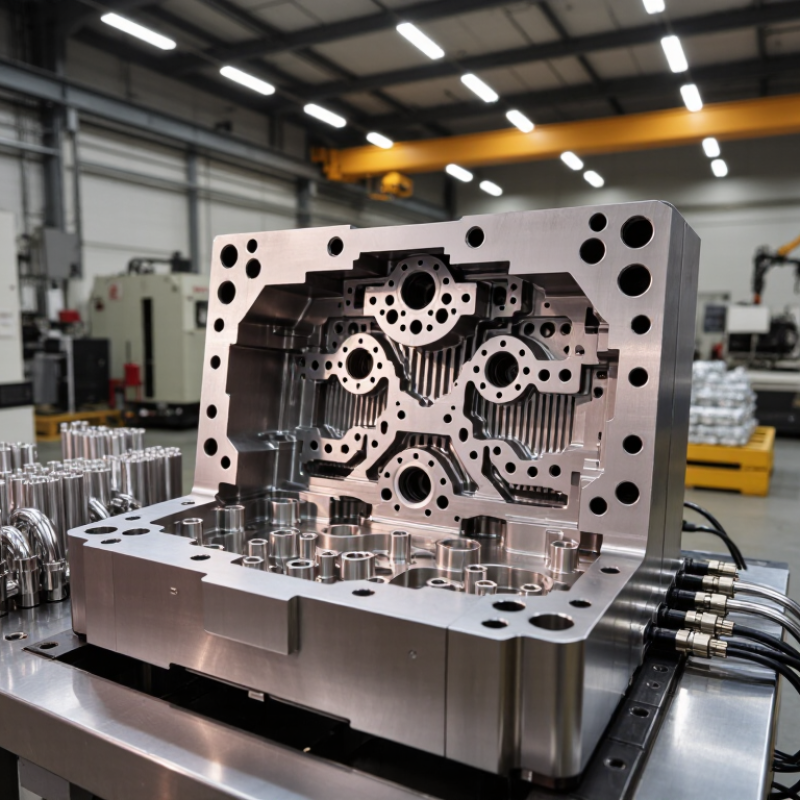
How to Choose an Aluminum Die Cast Mold in 2026?
What Is an Aluminum Die Cast Mold?
An aluminum die cast mold is a precision tool used to shape molten aluminum under high pressure. It is usually made from hardened tool steel, not aluminum. This distinction is easy to miss. The mold contains a cavity, core inserts, runners, gates, vents, cooling channels, and ejector pins. Together, these parts control filling, solidification, and part release.
In practical production, mold quality appears in small details. A smooth cavity surface can reduce drag marks on a thin housing. Balanced cooling channels can prevent distortion near thick ribs. Proper venting helps limit trapped air and visible porosity. I have found that a mold may look excellent in a drawing but perform poorly after repeated thermal cycling. Heat checking, worn parting lines, and blocked vents often reveal the real weaknesses.
When choosing a mold in 2026, review the alloy, wall thickness, annual volume, and required tolerances. Check whether the design supports replaceable inserts and accessible maintenance. Flow simulation and temperature monitoring can improve decisions, but they do not replace trial shots. Data helps. Shop-floor evidence matters more. A low-cost mold may seem attractive, yet frequent repairs can increase the true production cost. Even experienced teams sometimes underestimate cooling design. That deserves another review.
| Selection dimension | Typical data or range | Why it matters | Recommended choice |
|---|---|---|---|
| Mold definition | A reusable steel die containing a cavity, core, runners, gates, overflows, vents, ejectors, and cooling passages. | The die controls the casting geometry, filling pattern, cooling rate, dimensional accuracy, and surface finish. | Specify the complete die system rather than evaluating only the cavity block. |
| Casting process | Cold-chamber high-pressure die casting is the standard process for most aluminum alloys; gravity and low-pressure die casting are alternatives. | Process selection affects die construction, wall thickness capability, porosity, production speed, and equipment cost. | Use high-pressure die casting for high-volume, thin-wall parts; use gravity or low-pressure methods for larger, thicker, or lower-volume castings. |
| Aluminum alloy compatibility | Common die-casting alloys include aluminum-silicon and aluminum-silicon-copper families. Molten aluminum is typically processed near 660–730 °C, depending on alloy and practice. | Alloy temperature, silicon content, and chemical attack influence soldering, erosion, thermal fatigue, and die life. | Select die steel, heat treatment, surface treatment, and cooling layout for the exact alloy and melt temperature. |
| Die material | Hot-work tool steels such as H13-type grades are widely used because they combine hot strength, toughness, thermal-fatigue resistance, and polishability. | The material must withstand repeated heating and cooling, mechanical impact, abrasion, and aluminum soldering. | Use vacuum-melted or equivalent high-quality hot-work steel for demanding production; verify hardness and toughness after heat treatment. |
| Die hardness | A commonly specified range for hardened hot-work die steel is approximately 44–52 HRC, subject to grade, section size, and application. | Excessive hardness can reduce toughness; insufficient hardness can accelerate erosion, deformation, and wear. | Set the target hardness with the steel supplier and die maker rather than using one value for every component. |
| Part wall thickness | High-pressure aluminum die casting can produce thin walls commonly around 1.5–3.0 mm, depending on alloy, flow length, geometry, and machine capability. | Thin sections increase filling difficulty, heat-checking risk, air entrapment, and sensitivity to gate and vent design. | Use uniform walls, gradual transitions, adequate radii, and simulation-validated gates and vents. |
| Parting line and draft | Draft is often designed around approximately 0.5–2 degrees for die-cast surfaces, with higher values where texture, depth, or ejection resistance requires it. | Adequate draft reduces scuffing, sticking, ejector load, and damage during mold opening. | Define the parting line early and apply more draft to deep walls, textured surfaces, and moving core features. |
| Cooling system | Cooling channels are commonly positioned near the cavity surface while maintaining enough steel thickness for strength and sealing. | Balanced cooling controls cycle time, distortion, soldering, hot spots, and thermal fatigue. | Use conformal or optimized cooling where practical, and verify temperature balance with thermal analysis or trial measurements. |
| Ventilation and vacuum capability | Vents, overflows, and optional vacuum assistance remove air and gases from the cavity during rapid filling. | Poor evacuation can cause gas porosity, cold shuts, misruns, blisters, and reduced pressure-tightness. | Add vacuum-compatible sealing and controlled evacuation when structural integrity, welding, heat treatment, or leak-tightness is required. |
| Surface treatment | Nitriding and selected protective coatings can improve surface hardness, wear resistance, and resistance to aluminum soldering. | Treatment performance depends on steel cleanliness, heat treatment, surface preparation, and operating temperature. | Choose treatment after identifying the dominant failure mode: soldering, erosion, corrosion, or thermal fatigue. |
| Expected die life | Service life varies widely—from tens of thousands to several hundred thousand shots—depending on part size, alloy, cycle control, maintenance, and die design. | A single shot-life figure is not reliable without a defined part, process window, and maintenance plan. | Set a target life together with inspection intervals, repair allowances, spare inserts, and documented process controls. |
| Validation before production | Review 3D filling and solidification simulation, dimensional inspection, X-ray or CT when required, leak testing, and trial-shot records. | Validation identifies filling defects, shrinkage, deformation, cooling imbalance, and ejection problems before volume production. | Approve the mold only after the part meets dimensional, mechanical, cosmetic, and functional requirements under a stable process window. |
