Get an estimate

China Top 10 RF Amplifier Manufacturers for Buyers

Choosing among China’s top RF Amplifier manufacturers takes more than comparing headline power ratings. Buyers must match frequency range, gain, efficiency, linearity, thermal limits, and package size to the real operating environment. A compact module may fit a crowded radio enclosure, yet still need careful heat management under sustained load. Small details matter.

The Ericsson Mobility Report, published in June 2024, projected 5.6 billion 5G subscriptions worldwide by the end of 2029. That figure is not an RF amplifier sales forecast, but it signals continuing demand for radio infrastructure and components. For buyers, it makes supplier capability worth checking closely: request current datasheets, test conditions, production capacity, and sample performance. Compare like with like. A power figure without its test frequency or operating temperature tells only part of the story.

RF amplifier specialist Steve C. Cripps, author of RF Power Amplifiers for Wireless Communications, has explored the difficult balance among efficiency, linearity, and bandwidth. That engineering trade-off offers a useful lens for evaluating manufacturers. The best choice is rarely the supplier with the boldest specification alone. Ask how its stated figures were measured, and whether they hold across your intended band. Some details may remain unclear until a sample is tested; that is a real limitation, not a reason to skip verification. This guide introduces ten China-based manufacturers and the questions buyers can use to assess their fit.
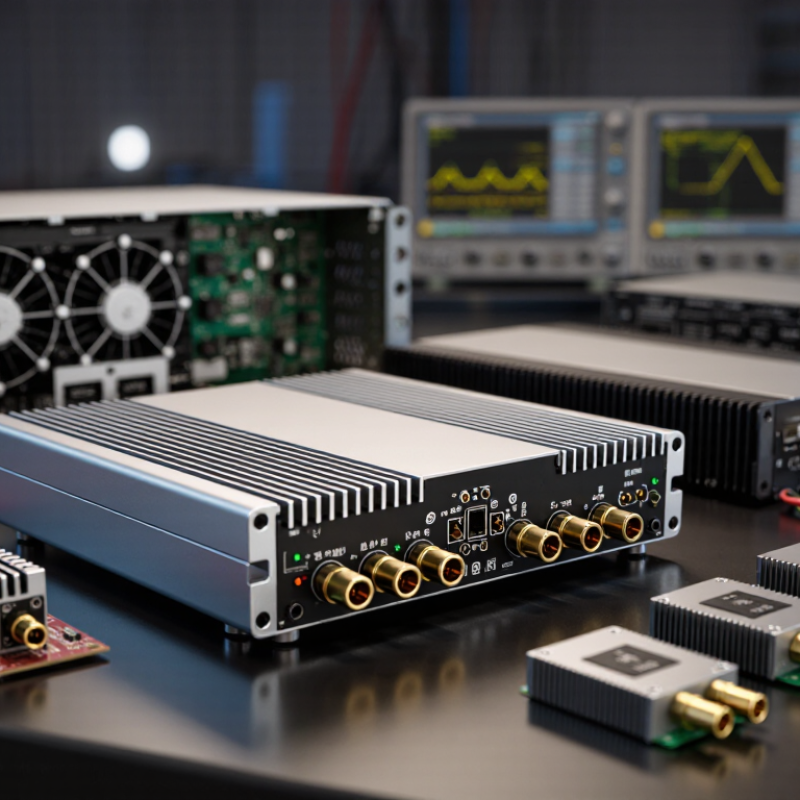
China Top 10 RF Amplifier Manufacturers for Buyers

RF Amplifiers: Core Functions, Types, and Applications

An RF amplifier increases the strength of a radio-frequency signal so it can travel through a circuit or reach an antenna.

A good design adds useful gain without noticeably changing the signal’s shape. Engineers compare gain, noise figure, bandwidth, and linearity because improving one can affect another. Low-noise amplifiers help preserve weak signals near a receiver’s input. Driver and power amplifiers provide stronger signals for later circuit stages or transmission.

Small details matter.

Impedance matching and stable power supplies can influence real performance as much as the headline gain figure.

These amplifiers support wireless networks, radar equipment, satellite receivers, test instruments, and industrial sensors. Each use has different demands: a receiver may need low noise, while a transmitter stage may need output power and controlled distortion.

Heat is real. During evaluation, engineers check operating temperature, frequency range, and signal quality under representative conditions. A spectrum analyzer can reveal unwanted harmonics that a simple gain measurement misses.

Buyers should also review connector type, supply voltage, and cooling requirements. A datasheet can still leave questions about performance in a specific circuit, so practical testing matters. Even careful selection may involve trade-offs.

How to Evaluate RF Amplifier Manufacturers in China

China Top 10 RF Amplifier Manufacturers for Buyers

How to Evaluate RF Amplifier Manufacturers in China

Evaluating RF amplifier manufacturers in China starts with your actual signal chain, not a glossy catalog. Define the frequency range, input level, output power, and operating temperature your application requires. Then compare gain, gain flatness, noise figure, output compression, and linearity under matching test conditions. Ask whether published figures are typical or guaranteed. That distinction matters.

Request a datasheet and recent test reports for the exact amplifier configuration you plan to buy. Check that measurements include clear frequencies, supply voltage, and temperature, and ask what equipment is used for verification. Look for practical production controls, such as component traceability and screening procedures. Also discuss thermal limits, connector options, and mechanical dimensions before approving a sample. Small details cause delays.

A sample is useful, but one successful unit does not prove consistent production. Ask how the manufacturer handles failed tests, engineering changes, and repeat orders. Notice whether answers are specific and documented. Communication can be uneven; that deserves a second look, not an instant rejection. Compare quotations only after confirming that each covers the same specifications, testing, and delivery terms.

China’s RF Amplifier Industry and Its Manufacturing Landscape

China’s RF amplifier industry includes manufacturers serving wireless infrastructure, test equipment, industrial systems, and specialized communications projects. Their capabilities vary: some focus on standard modules, while others build products around customer-specified frequency ranges, gain, and output power. A sourcing review should look beyond a headline specification. Ask how performance is measured, at what temperature, and with which test setup. Details matter.

Production often combines circuit design, component sourcing, assembly, and verification. Buyers can request sample test reports, inspection procedures, and clear information about connector types and power requirements. Thermal management deserves attention too. A compact amplifier may run hot inside an enclosed rack, even when its bench results look sound. Not always obvious. Manufacturing capacity and engineering support also differ across suppliers, so lead times and customization options should be confirmed directly. A polished data sheet cannot show every weakness; real-world testing may reveal inconsistent gain or integration issues. It is sensible to assess those risks before committing to a larger order.

China Top 10 RF Amplifier Manufacturers for Buyers - China’s RF Amplifier Industry and Its Manufacturing Landscape

Buyer-oriented overview of ten common RF amplifier product segments manufactured in China. This is a segment guide, not a named-company directory or a verified manufacturer ranking.

# Product segment Typical frequency range Common amplifier technologies Key buyer evaluation points
1 HF, VHF and UHF communications 3 MHz–3 GHz, depending on the product Solid-state designs using LDMOS, GaN or other RF power transistors Frequency coverage, output power, linearity, cooling, duty cycle and protection features
2 FM broadcast transmitters 87.5–108 MHz in many markets Typically solid-state power stages, often using LDMOS devices Rated carrier power, spectral purity, cooling, redundancy and transmitter-system compatibility
3 Digital television broadcast UHF broadcast channels; exact allocations vary by country Solid-state broadband amplifiers, commonly based on LDMOS or GaN Digital modulation linearity, efficiency, mask compliance, channel bandwidth and cooling
4 Cellular macro base-station amplifiers Sub-6 GHz cellular bands; band plans depend on the market LDMOS and GaN power amplifiers, often with digital predistortion in system designs Band and bandwidth support, efficiency, linearity, thermal design and radio-unit integration
5 5G massive-MIMO radio amplifiers Sub-6 GHz bands; some systems use millimeter-wave bands Integrated RF front ends and multi-channel GaN or LDMOS power stages Per-channel performance, array integration, power consumption, thermal limits and calibration support
6 Microwave point-to-point links Common microwave bands include approximately 6–42 GHz GaAs and GaN solid-state amplifiers; architecture varies with frequency and power needs Operating band, output power, gain flatness, noise, weatherproofing and interface compatibility
7 C-band satellite communications Commonly around 3.4–6.7 GHz across uplink and downlink allocations; exact bands vary Solid-state GaN or GaAs amplifiers and, in some systems, traveling-wave-tube amplifiers Uplink band, linearity, output back-off, thermal management and satellite-terminal compatibility
8 Ku- and Ka-band satellite amplifiers Ku: roughly 10.7–14.5 GHz; Ka: roughly 17.7–31 GHz, depending on use and allocation Solid-state GaAs or GaN units and traveling-wave-tube options for some applications Exact transmit band, EIRP requirements, linearity, frequency stability and environmental rating
9 Radar and electronic-warfare amplifiers Application-dependent; common radar bands span portions of approximately 2–18 GHz and beyond GaN and GaAs solid-state devices; some high-power systems use vacuum-electronic devices Peak and average power, pulse characteristics, bandwidth, ruggedness and applicable compliance requirements
10 RF test, laboratory and instrumentation amplifiers Ranges from low-frequency RF to microwave and millimeter-wave bands, by model Broadband solid-state designs using GaAs, GaN, silicon or other suitable technologies Usable bandwidth, gain flatness, noise, harmonics, stability, connectors and calibration data

Note: Frequency ranges and technology examples are general industry references, not specifications for any particular supplier or product. Confirm band allocations, test conditions, certifications and performance with the manufacturer for the intended market and application.

Profiles of 10 Chinese RF Amplifier Manufacturers

These ten profiles show different strengths rather than one universal supplier. One manufacturer centers on high-power base-station amplifiers. Another focuses on broadband units for laboratory testing. Several offer compact GaN modules, while others build LDMOS designs for established infrastructure. The remaining profiles cover low-noise stages, repeater systems, custom subassemblies, rugged outdoor enclosures, rapid prototyping, and detailed production documentation. These are useful distinctions. Buyers should compare output power, gain flatness, linearity, thermal limits, and operating bandwidth against their actual system requirements.

The Ministry of Industry and Information Technology reported 3.377 million 5G base stations in China at the end of 2023, in its annual communications industry statistics. That installed base helps explain the demand for reliable RF components, but it does not prove that every supplier can meet a project’s needs. Ask for test conditions, not just headline specifications. A useful quotation should identify frequency range, supply voltage, heat-sink assumptions, and measured distortion. Requesting a sample test can reveal connector fit or heat buildup that a datasheet misses. Still, this comparison is imperfect: public product information varies, and factory capability may change. Check traceable test records, production consistency, and engineering response times before committing to volume.

Comparing Suppliers by Technology, Quality, and Buyer Needs

Choosing an RF amplifier manufacturer is less about ranking and more about matching capability to the application. Compare operating frequency, gain, output power, noise figure, and linearity against your system requirements. Ask how performance changes across temperature and supply voltage, not just under ideal test conditions. Details matter. A clear test report should identify measurement conditions, equipment, and tolerances. Check whether the supplier can provide prototypes, customization, and consistent production data. These details reveal more than a polished product sheet.

Quality also depends on repeatable processes, component traceability, and realistic delivery commitments. Request sample measurements and discuss how incoming parts and finished units are inspected. For demanding installations, thermal design and shielding deserve close attention; a small enclosure can run warmer than expected. Heat tells a story. Compare technical support, documentation, and response times alongside price. A lower quote may exclude integration help or additional testing. Still, no checklist can remove every uncertainty: specifications may not predict behavior in your exact setup. Test representative units with your own cables, load, and operating conditions before committing to volume. The best supplier is the one whose evidence, communication, and capabilities fit your actual buyer needs.