
Global buyers need more than a compact camera board. They need a Dash Camera Module that delivers clear footage, stable performance, and dependable supply across changing conditions. A sharp view of a road sign at dusk matters. So does consistent operation after hours of vibration and heat. These details can separate a promising sample from a dependable production component.
China’s supplier landscape spans module makers, optics specialists, and electronics manufacturers. Their offerings may differ in sensor choice, lens design, image processing, interfaces, and customization support. One specification sheet rarely tells the whole story. Buyers should examine sample footage, ask how components are tested, and confirm production capacity before committing. Small gaps deserve attention.
For this guide, “Dr. Adrian Lin” is a fictional composite expert, not a real person or source. His illustrative perspective is: “A module earns trust when its image quality stays consistent beyond the showroom test.” Treat that line as editorial guidance, not a verified quotation. The comparison ahead focuses on practical sourcing questions: technical fit, quality controls, communication, and delivery readiness. It also leaves room for a useful caution. Supplier claims still need evidence. A clear answer today is encouraging, but repeatable results matter more. Buyers can use the following outline to compare candidates carefully and identify where further validation is needed.
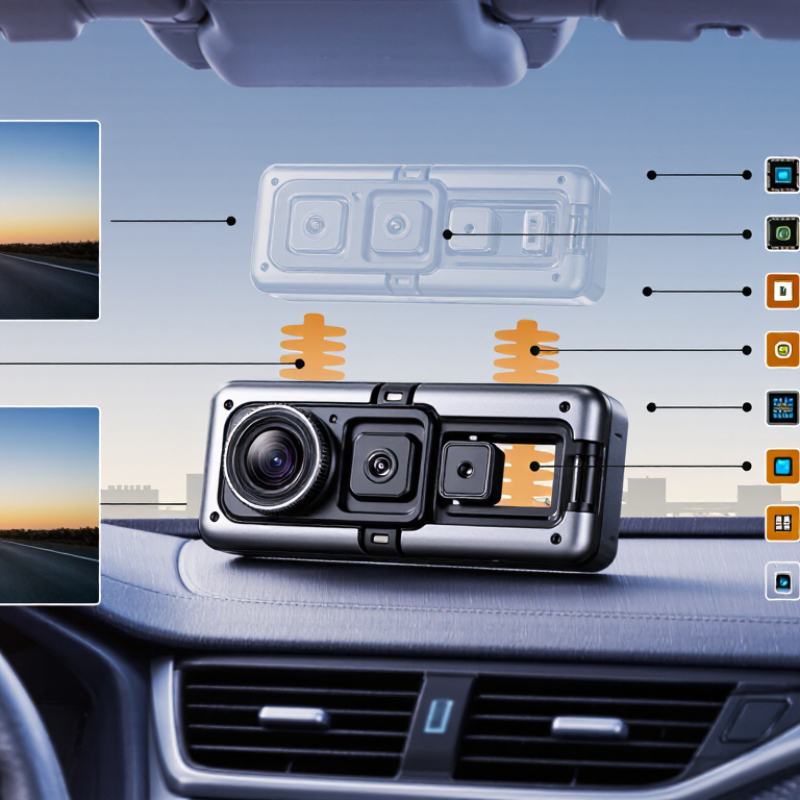
A dash camera module is the compact imaging unit inside a vehicle camera. It usually combines a lens, image sensor, processing electronics, and a circuit board. The lens gathers light and focuses it onto the sensor, which converts the scene into electrical data. Small details matter. Focus should remain stable across temperature changes and road vibration, not just during a sample-room test.
The image processor adjusts exposure, color, and noise, then prepares video for storage or transmission. A separate controller may manage recording and communication with the camera’s main unit. Power regulation helps protect sensitive components from changing vehicle voltage, while connectors carry power and data. Heat is easy to underestimate. A module mounted behind a windshield can face strong sun, and poor thermal design may shorten service life. Buyers should check sensor and lens compatibility, interface requirements, operating temperature, and sample performance under realistic lighting. Resolution alone tells little. A sharp daytime image can still lose useful detail at night, and specifications do not replace testing. That distinction is easy to miss.
| Module Component | What It Is | How It Works | Key Buyer Checks |
|---|---|---|---|
| Image sensor | A semiconductor sensor that converts incoming light into electrical signals. | Pixels capture light through the lens; the sensor reads and outputs image data for processing. Resolution, pixel size, readout mode, and low-light performance affect the result. | Confirm supported resolution and frame rates, image format, rolling- or global-shutter requirements, low-light test conditions, and whether the sensor is available for the required product life cycle. |
| Lens and optical assembly | The lens, lens holder, and related parts that focus a scene onto the image sensor. | Lens elements direct light onto the sensor. Focal length and field of view influence scene coverage, while focus, distortion, and optical alignment affect image clarity. | Check the stated field of view and how it is measured, focus range, distortion, aperture, infrared-filter configuration, alignment method, and performance across operating temperatures. |
| Image signal processor (ISP) | A processing unit, often integrated into a system-on-chip (SoC), that converts sensor data into viewable video. | The ISP can perform operations such as demosaicing, exposure adjustment, white balance, noise reduction, and color processing. Available functions depend on the chip and its software. | Request sample footage in daylight, low light, and high-contrast scenes. Verify supported sensor modes, image-processing controls, firmware access, and the video formats required by the final product. |
| Video encoder and processor | Hardware and software that prepare video streams for storage or transmission. | Video encoding compresses image data into a format such as H.264 or H.265, when supported. The processor may also coordinate recording, menus, event handling, and multiple camera inputs. | Confirm codec and profile support, resolution and frame-rate combinations, number of simultaneous streams, and sustained recording performance under the intended workload. |
| Memory and storage interface | Working memory and an interface for removable or built-in storage. | RAM supports active processing, while storage holds recorded video. Many dash cameras use a microSD card; card capacity, write speed, file system, and card compatibility affect reliable recording. | Check supported card types and capacities, minimum write-speed requirements, loop-recording behavior, file recovery after power loss, and endurance testing with the intended card specification. |
| Power management | Power-conversion and protection circuitry for the module and connected camera system. | Vehicle electrical systems commonly use nominal 12 V or 24 V supplies. A power stage converts the input to the lower voltages needed by the sensor, processor, and memory; protection design helps address electrical disturbances. | Verify the actual input-voltage range, power consumption, startup behavior, reverse-polarity and transient protection requirements, and the vehicle-specific power design. Do not connect a low-voltage module directly to vehicle power unless designed for it. |
| PCB, connectors, and interfaces | The circuit board and electrical connections linking the sensor, processor, storage, and external equipment. | Board traces carry power and data. Depending on the design, interfaces may include MIPI CSI-2 between sensor and processor, USB for data or service, or other board-level and external connections. | Review interface versions, pin assignments, connector retention, cable length limits, signal-integrity needs, board dimensions, and the availability of schematics or integration documentation. |
| Thermal design and enclosure | Mechanical parts and heat-management features that protect and position the module. | The enclosure holds the optical assembly in alignment and shields electronics. Heat flows from components through the PCB and housing; temperature can affect image quality, reliability, and component life. | Assess operating and storage temperature ratings for the complete assembly, heat dissipation, vibration resistance, mounting method, ingress protection if specified, and focus stability after thermal cycling. |
| Firmware and image tuning | Embedded software and calibration settings that control recording and image behavior. | Firmware configures sensor operation, exposure, encoding, recording, and supported features. Image tuning adjusts processing for the lens, sensor, and intended scene conditions. | Clarify firmware ownership and update method, customization scope, language and regional requirements, configuration tools, defect-fix process, and validation using production-equivalent hardware. |
| Supplier validation and production control | Processes used to check that modules meet agreed requirements consistently. | Engineering samples, pilot builds, and production inspections help identify design and manufacturing variation. Test coverage may include image performance, electrical behavior, mechanical fit, and environmental reliability. | Request a written specification, sample test reports, change-control procedure, traceability details, quality-system information, production capacity evidence, and a clear process for handling nonconforming units. |
